
Most SEO tools tell you what is wrong. They hand you a checklist: fix this meta tag, compress that image, add a keyword here. You do the work, re-run the audit, and hope the numbers go up. Weeks later, you check your rankings and wonder why nothing changed.
That cycle ends on 15 May 2026 when we launch Goedly SEO -- the best SEO analytics engine worldwide. Not because it produces a longer checklist, but because it does not produce a checklist at all. It tracks everything, analyzes everything, finds the problems, generates the fixes, and presents them to you for one-click approval. Automatically. Continuously. Strategically.
- Goedly SEO observes real user behavior, not just lab metrics and keyword counts.
- It merges search, behavioral, and competitive context before making recommendations.
- It closes the execution gap by generating deployable fixes, not generic advice.
Why existing SEO tools fall short
The SEO industry has settled into a comfortable pattern. Tools audit your site, produce a score, list recommendations, and leave the rest to you. Even the best platforms -- whether they focus on Lighthouse performance metrics or keyword density analysis -- share the same fundamental limitation: they stop at diagnosis.
That creates three problems:
- Execution gap. Knowing what to fix and actually fixing it are entirely different skills. Most small business owners lack the technical knowledge to implement SEO recommendations, and hiring someone to do it costs more than the tool itself.
- Static analysis. Traditional tools look at your site in isolation, at a single point in time. Search engines do not work that way. Rankings are relative, dynamic, and influenced by hundreds of factors that change daily.
- Surface-level optimization. Lighthouse scores and keyword counts are proxy metrics. A perfect Lighthouse score does not guarantee first-page placement. High keyword density can actually hurt rankings. These tools optimize for the wrong target.
Goedly SEO was built from scratch to address all three.
The nervous system: tracking at surgical precision
The foundation of Goedly SEO is a lightweight tracking layer embedded in every customer site. No third-party pixels. No Google Analytics. You own all the data. It is first-party, server-side, and privacy-compliant by design.
This is not basic pageview counting. The system captures every meaningful signal that reveals how visitors actually interact with your site:
Important: the visuals in this article are conceptual illustrations of the system model, not literal screenshots of customer analytics or live measured output.
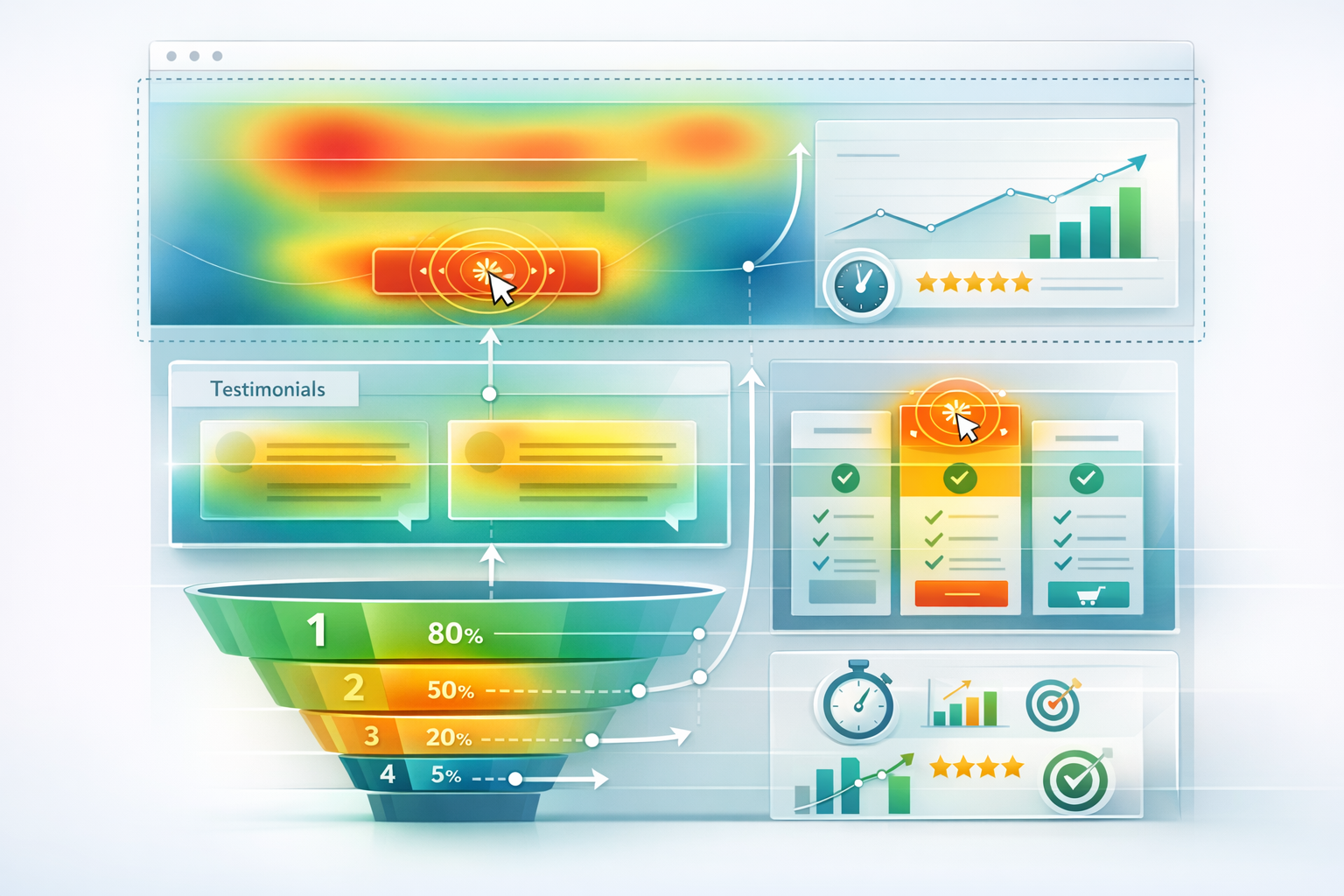
Behavioral intelligence
- Real time-on-page: measured using the Page Visibility API -- not the broken method most analytics tools use. When someone switches tabs, the clock stops. You get actual reading time, not inflated numbers.
- Scroll depth and velocity: not just "did they scroll to 50%," but how fast they scrolled, whether they read slowly or skimmed, and whether they scrolled back up to re-read a section. If 80% of visitors never scroll past your hero section, your CTA placement is wrong. If people keep scrolling back to your pricing table, they are comparison shopping.
- Element-level attention tracking: using IntersectionObserver, the engine tracks how long every important element -- images, CTAs, testimonials, pricing cards, headings -- stays in the visitor's viewport. This produces data like: "Testimonial section: avg 6.2s attention, but only 31% of mobile visitors ever reach it." That is a layout problem the engine can fix.
- Click and interaction mapping: every click captured with context -- CTA clicks, email link clicks, phone number taps, form submissions, copy events (someone copied your address or phone number -- high intent), even print events.
- Frustration signals: rage clicking on non-interactive elements, repeated form field corrections, quick bounces under 5 seconds, excessive mobile zoom (content too small). These reveal UX problems that directly hurt conversion and ranking.
Conversion funnel tracking
The engine defines a funnel per site type and tracks drop-off at each stage with exact numbers. For a service business: visit, scroll to contact section, click email or phone, conversion. For lead generation: visit, CTA click, form view, form submit, thank-you page. When the engine sees that 67% of visitors view the pricing table for an average of 8.1 seconds but only 12% ever see the CTA button below it, it knows exactly where the funnel breaks.
Real User Monitoring
Core Web Vitals collected from actual visitors, not from a lab test: LCP, INP, CLS, FCP, TTFB. Broken down per page, per device type, per country. Real performance data from real users on real networks is worth infinitely more than a single Lighthouse run from a data center.
The eyes: search engine data at every level
Tracking tells you what happens on your site. But to optimize placement, you need to understand what happens before visitors arrive -- and what your competitors are doing.
Search Console and Bing Webmaster integration
Every Goedly site is auto-verified with Google Search Console and Bing Webmaster Tools at deploy time. The engine pulls data daily: which queries bring impressions, which get clicks, what your click-through rate is per query, what position you hold, which pages are indexed, how often crawlers visit. This covers Google, Bing, Yahoo, and DuckDuckGo.
SERP monitoring
For your top target queries, the engine periodically checks what the search results page actually looks like. It tracks your position, whether rich results appear, whether an AI Overview is present, whether you have sitelinks, and where your competitors rank. This is how it detects threats early: "An AI Overview just appeared for your main keyword -- your competitor is cited, you are not. Here is the structured data and content change needed to get cited."
Competitive intelligence
At onboarding, the system identifies 3-5 competitors. It runs the same SERP monitoring for their domains, tracks their ranking changes, new content, and schema additions. It monitors backlink profiles -- new links gained, links lost, anchor text distribution. When a competitor makes a move, the engine knows and can respond before you lose ground.
Market context
Keyword volume data converts raw impressions into total market size, giving you share-of-voice metrics. Over time, as the engine accumulates data across all customer sites, it builds industry benchmarks: average CTR for plumbers in Austria, typical conversion rates for real estate sites, expected scroll depth for service business homepages. This proprietary intelligence makes every recommendation more accurate.
The brain: AI analysis that connects the dots
Here is where Goedly SEO fundamentally diverges from everything else on the market. Every week, the AI analysis pipeline runs per customer site. It pulls the last 7 days of tracking data, the latest Search Console and Bing data, current SERP snapshots, competitive intelligence, and runs a fresh technical audit. Then it feeds everything into an AI engine with one instruction: identify the top revenue opportunities and generate specific changes to capture them.
The power is in the combination. No single data source tells the full story. But when you cross-reference tracking data with search data with competitive data, patterns emerge that no human analyst could find manually:

"Users arriving via 'plumber linz emergency' have an 85% bounce rate, but the page they land on has no phone number above the fold. Add a click-to-call button in the hero. Estimated impact: +12 calls per month."
Or: "You hold position 4 for 'website redesign' with a 2.1% CTR. The average CTR for position 4 is 7%. Your meta description is generic. Here is a rewrite that matches the search intent. Estimated lift: +40 clicks per month."
Or: "Your testimonial section gets 6.2 seconds of average attention, but it sits below the fold for 60% of mobile users. Move it above the comparison table. Similar changes on other sites improved conversion by 15-25%."
Or: "An AI Overview appeared for your primary keyword last week. Your site is not cited. Your competitor is, because they have FAQ schema and a direct-answer paragraph. Here is the FAQ schema and content block to add. Estimated defensive value: prevent 30% CTR erosion."
From finding issues to fixing them -- automatically
The AI does not just describe the problem. It generates the actual fix:
- New meta title and description -- exact text, ready to deploy
- Schema additions -- exact JSON-LD, validated
- Content restructuring -- exact HTML blocks
- CSS adjustments -- exact rules for layout changes
- New page sections -- full HTML with copy
- Image optimizations -- automated compression and format conversion
- Internal linking improvements -- specific links to add between pages
Behavior, rankings, crawl signals, and SERP changes enter one operating view.
The engine benchmarks your pages against search intent, competitors, and prior site performance.
It turns the gap into deployable meta, schema, layout, content, and linking changes.
High-impact changes are staged with plain-language reasoning and estimated upside.
Goedly-hosted sites can push the approved change directly into production.
The outcome feeds the next cycle so the system improves with every release.
Every generated fix is staged as a preview. For Goedly-hosted sites, the customer receives a plain-language explanation of what the change does, why it matters, an estimate of the revenue impact, and a one-click approval link. Reply "yes" or click the button. The change goes live. No technical knowledge required.
Low-risk fixes -- broken links, missing alt text, schema errors -- are applied automatically and the customer is simply notified after the fact. High-impact changes always wait for approval.
Strategic self-optimization over time
The most powerful aspect of Goedly SEO is the feedback loop. Every change the engine makes generates new data. Thirty days after a fix is applied, the system measures: did the ranking change? Did CTR improve? Did conversions increase? The result is stored. Over time, a pattern library emerges: "Title rewrites improve CTR by an average of 23% across our customer base. Schema additions lead to rich results within 14 days for 68% of sites."
The engine stops guessing and starts knowing. And because it learns across all customer sites, every customer benefits from the collective intelligence.
What this looks like in practice
- Week 1: Full audit. All technical issues fixed. Baseline metrics established across every dimension -- tracking, search, competitive, behavioral.
- Month 1: Content optimizations applied based on competitive analysis. The engine identifies your highest-potential keywords, rewrites meta descriptions, adds missing structured data, and restructures content around search intent.
- Month 3: Enough behavioral and ranking data to identify which changes produced results and which did not. The engine doubles down on what works, revises what did not, and starts making predictions: "Based on current trends, you will lose position for this query in ~4 weeks unless we strengthen the page."
- Month 6+: The system operates with deep knowledge of your site, your market, and your audience. Optimizations become surgical. Your placement improves not through brute force but through strategic, data-driven refinement that compounds over time.
This is not set-and-forget. It is set-and-improve. The longer it runs, the better it gets.
What you receive as a customer
No dashboards you will never check. No reports full of jargon. You get a monthly email that reads like it was written by a person:
"Hi Gerhart,
Here is how your site performed in March: 482 visitors from Google (+18% vs February). You rank #3 for 'immobilien st. johann' -- up from #5 last month. 34 people clicked your phone number, 12 submitted the contact form. Estimated revenue from organic traffic: EUR 4,200.
We noticed two opportunities: (1) Your 'Projekte' page gets 200 impressions per month but only 2% CTR. We have rewritten the meta description to better match what people search for. Preview and approve here. (2) A new AI Overview appeared for 'grundstueck kaufen steiermark'. We have added structured data to help your site get cited. Preview and approve here.
No action needed if you are happy with the current setup."
Clear numbers. Clear opportunities. One-click approval. That is it.
Privacy-first by architecture
Every piece of data Goedly SEO collects is first-party. Your domain, your server, your data. No third-party cookies, no external pixels, no data leaving the EU. IP addresses are used for geo lookup and immediately discarded -- never stored. Visitor IDs are anonymous with no personally identifiable information linkage. This is orders of magnitude more privacy-friendly than Google Analytics or any third-party tracking tool. GDPR-compliant by design, not by afterthought.
Built on Goedly's infrastructure
Goedly SEO is a natural extension of what we already do. We build and host websites for businesses. We manage their performance, their updates, their infrastructure. We control the hosting, the DNS, the deployment pipeline. That means the SEO engine has full access to your site's code, content, and environment. Zero friction between identifying an improvement and deploying it.
For existing Goedly customers, SEO optimization integrates directly into the managed website service. As the rollout expands, we will share more about how businesses not yet on Goedly can get access to the same operating model.
What this means for small businesses
SEO has always been something small businesses know they need but struggle to execute. The tools are complicated, the advice is contradictory, the results are slow, and hiring an SEO agency costs thousands per month with no guaranteed outcome.
Goedly SEO changes that equation entirely. Instead of learning SEO, paying an agency, or ignoring it and hoping for the best, you get an autonomous intelligence system that tracks, analyzes, generates fixes, and improves your placement over time -- at a fraction of what manual SEO services cost.
Your website gets better at being found, every single day, without you lifting a finger.
Launch details
Goedly SEO launches on 15 May 2026. It will roll out as part of Goedly's managed website service, with broader access details to follow.
We will share detailed pricing, feature breakdowns, and early access information in the coming weeks. If you want to be the first to know, get in touch.
Ready to stop optimizing manually?
Get your business online with Goedly and be among the first to benefit from an AI-powered SEO engine that tracks everything, fixes everything, and gets smarter every month.